
Published: June 9, 2026 | Last updated: June 9, 2026 | 12 min read
TL;DR
- Public cloud resources are shared across many organizations, managed by a third-party provider, and priced on a pay-as-you-go basis. Private cloud is dedicated to one organization, offering full control, higher security, and predictable (but higher) costs.
- About 94% of enterprises now use cloud services in some form, with roughly 78% operating a hybrid model that combines both, per DataStackHub Cloud Adoption Statistics (2026).
- The global cloud market sits at approximately $917.9 billion in 2026, on track to cross $1 trillion before year-end, per Persistence Market Research (2026).
- By 2028, 40% of large enterprises will run private clouds specifically for AI workloads, driven by data privacy laws and concerns about intellectual property exposure, per IDC Cloud FutureScape (2026).
- The right answer for most organizations isn’t public or private — it’s knowing which workloads belong where.
Public vs Private Cloud: Why the Difference Matters in 2026
Public vs private cloud is not a new debate. But the stakes changed in 2026. AI workloads, tightening data sovereignty laws, a string of high-profile cloud provider outages, and rising infrastructure costs have pushed this decision back to the boardroom — not just the platform team.
Getting it wrong costs money. Sometimes a lot of it. Organizations that chose public cloud for everything without a workload-mapping strategy are now paying infrastructure bills that dwarf what they projected. Others that locked into expensive private infrastructure for workloads that didn’t need it are sitting on underutilized hardware.
This article covers the concrete differences, the real-world trade-offs, and the decision framework that actually works.
What Is Public Cloud?
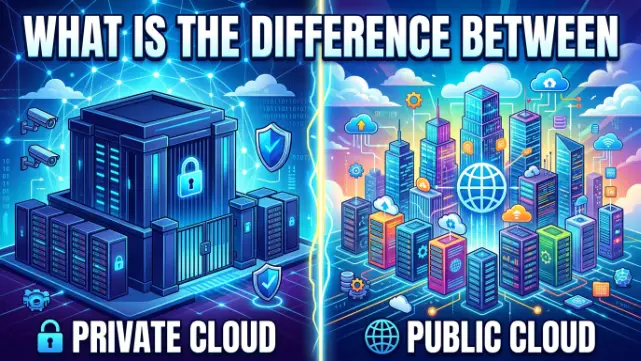
Public cloud delivers computing resources — servers, storage, networking, databases, and applications — over the internet from infrastructure owned and operated by a third-party provider. Multiple organizations share the same physical hardware, kept logically separate through virtualization. You pay only for what you use, on a metered or subscription basis.
The three dominant providers in 2026 are Amazon Web Services (AWS), Microsoft Azure, and Google Cloud Platform (GCP), which together control 68% of global cloud infrastructure spend as of Q1 2026, per Synergy Research Group Q1 2026. AWS alone holds 31% market share; Azure sits at 24%; GCP holds 13%, per Tech Insider (2026).
The defining features of public cloud are elasticity, breadth of services, and zero upfront capital cost. You don’t buy servers. You don’t lease data center floor space. You don’t hire a team to manage hardware. You provision resources through a web console or API and start running workloads within minutes.
That simplicity is why 89% of enterprises now use two or more public cloud providers, per Flexera 2026 State of the Cloud Report.
What Is Private Cloud?
Private cloud is dedicated cloud infrastructure used exclusively by one organization. It may be hosted on-premises in the company’s own data center, at a colocation facility, or by a managed private cloud provider — but the key distinction is that the hardware, network, and resources are not shared with any other organization.
This dedicated architecture is what enables the core private cloud advantages: full control over configurations, predictable performance, isolated security boundaries, and the ability to enforce compliance requirements without depending on a provider’s shared-environment controls.
The trade-off is cost and management overhead. Private cloud requires significant capital investment or contracted dedicated infrastructure spend, plus an in-house or contracted team to manage it. Per SWK Technologies (2026), private cloud still depends on human action for policy enforcement, which means local operational errors can create security gaps if monitoring is inconsistent.
Private cloud is not niche. The shift toward it is accelerating. Per Broadcom’s 2026 private cloud predictions, cloud repatriation has moved from ad-hoc cost-cutting to a deliberate strategy for control, resilience, and sovereignty. Board-level conversations are shifting from “how much can we move to public cloud” to “which workloads must we control end-to-end.”
The 7 Core Differences: Public Cloud vs Private Cloud
1. Infrastructure Ownership
Public cloud: The provider owns all hardware. You rent capacity. You never touch a server.
Private cloud: Your organization owns or exclusively leases the hardware. You control every layer of the stack, from physical to application.
This distinction drives nearly every other difference on this list. Ownership determines cost structure, security posture, compliance capability, and performance consistency.
2. Cost Structure
Public cloud has no upfront capital expenditure. You pay monthly for exactly what you consume. This works well for variable or unpredictable workloads. It becomes expensive for stable, predictable workloads running at consistent high utilization — where private infrastructure’s fixed cost eventually beats the per-hour public cloud rate.
Private cloud carries significant upfront capital cost. Hardware, networking, software licensing, and staffing all need to be budgeted before you run a single workload. Total cost of ownership calculations typically favor private cloud when utilization is consistently above 60-70% and workloads run unchanged for 3+ years.
One concrete comparison: average large-enterprise cloud spend has reached $14.3 million per year on public cloud, a 9% year-over-year increase, per Flexera 2026 State of the Cloud Report. Many of those organizations run workloads that would cost less on dedicated private infrastructure at that scale.
3. Security and Isolation
Public cloud: Security is a shared responsibility. The provider secures the physical infrastructure and core network. You secure what runs inside it — access controls, encryption, application configuration, user permissions. Eighty-two percent of breaches in 2025 occurred in cloud-based environments, many originating through misconfigured SaaS connections and legacy servers, per IBM Security 2025, cited by SWK Technologies (2026).
Private cloud: Security boundaries are fully within your control. No other organization’s data or workloads run on the same physical hardware. Compliance controls, encryption standards, and access policies are yours to set and audit without a shared-environment constraint. This is why healthcare organizations handling Protected Health Information (PHI) under HIPAA and financial firms managing payment card data under PCI DSS consistently favor private or hybrid environments for their most sensitive systems.
Worth stating clearly: private cloud is not automatically more secure than public cloud. Security depends on how each environment is configured and monitored. A poorly managed private cloud carries its own risks. The difference is that private cloud puts all controls — and all responsibility — in one place: your organization.
4. Scalability
This is where public cloud wins clearly. And it matters.
Public cloud scales in minutes. Provision ten extra servers for a traffic spike, release them two hours later, pay only for those two hours. No procurement cycle. No lead time. No physical capacity constraint.
Private cloud scales in weeks or months. Adding capacity means purchasing hardware, shipping it, racking it, cabling it, and configuring it. For workloads with unpredictable peaks — a consumer app, a news site, a seasonal retailer — that lag is operationally unacceptable.
That said, private cloud can scale adequately for organizations with predictable growth and the operational maturity to plan hardware cycles in advance. It’s not a static environment. It’s just slower to scale than public.
5. Compliance and Data Sovereignty
Forty percent of organizations cite compliance and data sovereignty as a primary blocker for running certain workloads on public cloud, per DataStackHub Cloud Adoption Statistics (2026).
This is the fastest-growing driver of private cloud adoption in 2026. Regulations governing where data can physically reside — GDPR in Europe, PDPA in Southeast Asia, data localization laws emerging across the Middle East and Latin America — create explicit barriers to running certain workloads on shared global infrastructure controlled by US hyperscalers.
Per Gartner, cited by TruefFoundry (2025), over 75% of European and Middle Eastern enterprises will have moved virtual workloads to sovereign or local environments by 2030, up from less than 5% in 2025. Gartner calls this “geopatriation” — repatriating cloud workloads to environments the organization can directly control for legal and geopolitical reasons.
Private cloud gives organizations a clean answer to any data residency audit: we know exactly where the data is, we control the hardware it runs on, and no third-party provider has access to it.
6. Customization and Control
Public cloud services run on standardized configurations. You select from menus of predefined instance types, storage tiers, and networking options. Customization exists but within the bounds the provider defines.
Private cloud gives you the ability to configure hardware, networking, operating systems, security policies, and software stacks exactly as your workload requires. This matters most for specialized applications — high-frequency trading systems that need sub-millisecond latency, scientific computing environments with unusual memory configurations, or legacy applications that require specific software versions the public cloud no longer supports natively.
Per Hewlett Packard Enterprise (2026), private cloud allows control over every component of the environment, while public cloud limits customization to what the provider offers as standard.
7. Performance Consistency
Public cloud performance can vary. Shared physical hardware means that “noisy neighbor” effects — other tenants consuming disproportionate resources on the same physical host — can degrade your workload’s performance unpredictably. Providers have improved isolation over time, but the issue hasn’t disappeared entirely.
Private cloud delivers consistent, dedicated performance. Your workload has exclusive access to the hardware it runs on. No contention. For latency-sensitive applications, financial trading systems, or real-time industrial control systems, that consistency is worth paying for.
Side-by-Side Comparison Table
| Dimension | Public Cloud | Private Cloud |
|---|---|---|
| Infrastructure ownership | Provider-owned, shared | Org-owned or dedicated |
| Upfront cost | Zero capex | High capex or contracted |
| Ongoing cost | Variable, pay-per-use | Fixed, predictable |
| Scalability | Minutes, unlimited | Weeks, capacity-limited |
| Security control | Shared responsibility | Full organizational control |
| Compliance posture | Provider certifications | Fully auditable by org |
| Customization | Provider menu options | Full stack control |
| Performance | Variable (noisy neighbor risk) | Consistent, dedicated |
| Best for | Variable workloads, startups, dev/test | Sensitive data, compliance, AI at scale |
What Is Hybrid Cloud? Where Most Organizations Land
Hybrid cloud combines public and private environments, connecting them so workloads can move between them based on requirements. It’s not a compromise — it’s the model most large organizations use intentionally, because different workloads have genuinely different needs.
About 78% of enterprises run hybrid cloud architectures, per DataStackHub (2026). The standard pattern: sensitive data, regulated workloads, and core business systems run on private cloud. Development environments, burst capacity, customer-facing apps, and collaboration tools run on public cloud.
This isn’t a new idea. The practical execution got significantly harder with the rise of AI workloads in 2024-2026, because AI training and inference have unusual infrastructure requirements that don’t fit neatly into either model.
A useful mental model: treat cloud deployment like a supply chain decision. Some inputs you produce yourself (private), some you buy from a vendor (public), and you integrate them based on quality, cost, and control requirements.
Case Study: How a Hospital Network Navigated the Public vs Private Decision
This pattern comes directly from real decision-making in regulated industries, worth mapping out because it shows how the theory translates to operational reality.
A mid-size regional hospital network with four facilities and roughly 2,400 staff began a cloud migration in early 2024. The initial instinct was to move everything to public cloud — lower upfront cost, faster setup, and the major providers all offered HIPAA Business Associate Agreements (BAAs).
But the compliance and IT teams ran into a problem quickly. Patient electronic health records (EHRs), medical imaging data, and billing information couldn’t simply sit on shared infrastructure, even with a BAA in place. State-level data localization requirements, their own liability insurance terms, and the hospital board’s risk appetite all pointed in the same direction: patient data needed to live on infrastructure the hospital controlled.
Healthcare data breaches remain the most expensive of any industry, averaging $7.42 million per incident and holding that position for 14 consecutive years, per IBM Cost of a Data Breach Report (2025). For a mid-size hospital network, a single breach at that cost is an existential event.
The outcome was a deliberate hybrid architecture. EHR systems, imaging archives, and billing data moved to a private cloud hosted at a colocation facility with direct fiber connection to all four hospital locations. Collaboration tools, staff scheduling applications, email infrastructure, and development environments moved to public cloud. Non-clinical analytics and reporting ran on public cloud with de-identified data only.
The decision wasn’t ideological. It was workload-by-workload. Each system was assessed for data sensitivity, regulatory classification, performance requirements, and breach cost exposure. Systems that failed one or more of those tests stayed on private infrastructure. Everything else went public.
That’s the model worth borrowing.
The Emerging Third Factor: AI Workloads Are Changing the Calculus
This is the shift most public vs private cloud comparisons written before 2025 don’t cover adequately. Worth including here because it’s actively reshaping how organizations think about the decision.
By 2028, 40% of large enterprises will adopt private clouds specifically for their AI workloads, per IDC Cloud FutureScape (2026). The concern is not primarily cost. It’s two things: data governance and intellectual property protection.
When you send training data or inference queries to a public cloud AI service, that data crosses infrastructure you don’t control, processed by models you don’t govern, potentially retained in ways your privacy policy doesn’t account for. For organizations training AI models on customer data, proprietary research, or competitive intelligence, that exposure is unacceptable.
Private cloud solves it. Run the model on your infrastructure. The data never leaves your environment. You maintain full audit trails and complete control over how AI components interact with your data.
Per Broadcom’s 2026 private cloud predictions, the economic center of gravity in private cloud is quietly shifting from CPUs to memory in 2026, driven by AI workloads’ unusually high memory requirements. Organizations building serious AI capabilities on private infrastructure should factor that into hardware planning cycles today.
How to Decide: A Workload-by-Workload Decision Framework
The mistake most organizations make is choosing a cloud model first, then fitting workloads into that choice. Better to work in the other direction.
For each major workload or data category, ask these five questions:
1. What is the data classification? Public, internal, confidential, or restricted? Restricted data — patient records, payment data, IP-sensitive processes, AI training sets — belongs on private infrastructure by default.
2. What are the compliance requirements? HIPAA, GDPR, PCI DSS, FedRAMP, or local data residency laws? Some regulations effectively mandate private or sovereign environments for certain data types.
3. What is the utilization pattern? Predictable, high-utilization workloads running at 70%+ consistently favor private cloud economics. Variable, bursty, or unpredictable workloads favor public cloud elasticity.
4. What is the latency requirement? Sub-millisecond latency needs dedicated, local infrastructure. Standard web application latency is fine on public cloud from a well-placed region.
5. What is the breach cost exposure? If a breach in this workload’s data would cost the organization $5M+, the economics of private cloud look very different than if it would cost $50K.
Map every workload against these five questions. The architecture emerges from the answers, not from a top-down preference for one model.
Common Mistakes When Choosing Between Public and Private Cloud
- Treating it as an all-or-nothing decision. Almost no organization at any meaningful scale runs 100% of one model. The question is always which workloads go where.
- Ignoring egress costs. Public cloud providers charge for data moving out of their environment. Organizations with large data volumes moving between cloud and on-premises regularly often underestimate this cost significantly. Get the egress math right before committing.
- Assuming private cloud is automatically more secure. A misconfigured private cloud is not more secure than a well-managed public cloud. Security depends on execution, not model selection.
- Choosing public cloud for cost reasons, then ignoring cost management. Over 20% of organizations report they have little to no idea what different aspects of their business cost in relation to cloud, per CloudZero State of Cloud Cost (2024). Public cloud cost visibility requires active FinOps practice, not just a bill review once a quarter.
- Planning private cloud without factoring in refresh cycles. Private hardware doesn’t last forever. A 3-year total cost comparison that doesn’t include hardware refresh, software licensing renewal, and staffing continuity is underestimating true private cloud cost.
Frequently Asked Questions About Public vs Private Cloud
What is the main difference between public and private cloud?
Public cloud is shared infrastructure owned by a third-party provider, accessed over the internet on a pay-per-use model. Private cloud is dedicated infrastructure used by a single organization, offering full control and isolation. The core trade-off is cost and flexibility (public) versus control and security (private).
Which is more secure: public or private cloud?
Neither is inherently more secure. Security depends on configuration and management. Public cloud uses a shared responsibility model where the provider secures physical infrastructure and the customer secures what runs on it. Private cloud puts all security responsibility with the organization, which can be an advantage or a liability depending on internal capabilities.
Is private cloud more expensive than public cloud?
Usually yes, for smaller or variable workloads. For large, stable, high-utilization workloads, private cloud can be less expensive over a 3-5 year horizon because the fixed cost per unit of compute often beats the public cloud hourly rate at scale.
What is hybrid cloud and how does it relate to public and private?
Hybrid cloud combines public and private environments, connecting them so workloads can move between them. About 78% of enterprises use hybrid architectures, per DataStackHub (2026), because different workloads have genuinely different requirements that no single model serves optimally.
Who should use private cloud?
Organizations with strong compliance requirements (healthcare, finance, government), those handling sensitive data with data residency restrictions, and enterprises building or running AI workloads on proprietary data. By 2028, 40% of large enterprises will use private cloud for AI workloads specifically, per IDC Cloud FutureScape (2026).
Can a small business use private cloud?
Technically yes, but rarely cost-effectively. The upfront investment and ongoing management requirements of private cloud typically require IT staffing and capital budgets that small businesses don’t have. Most small businesses are better served by public cloud, with private cloud reconsidered as they grow toward 50+ employees with regulated data requirements.
What is sovereign cloud and how is it different from private cloud?
Sovereign cloud is a specific type of private or dedicated cloud infrastructure designed to meet a country’s or region’s legal requirements for data residency and government access. AWS’s European Sovereign Cloud (entering general availability in 2026) and Google’s Sovereign Cloud Hub in Munich are examples, per Cloud Latitude (2026). Private cloud is about organizational control; sovereign cloud is about jurisdictional compliance.
What is driving the return to private cloud in 2026?
Three primary forces: AI workload data governance requirements, tightening data sovereignty regulations across multiple regions, and cost optimization for stable high-utilization workloads. Cloud repatriation has shifted from ad-hoc to strategic, per Broadcom (2026).
Key Takeaways
- Public cloud delivers elasticity, zero upfront cost, and breadth of services. Private cloud delivers control, security isolation, and performance consistency. Neither is universally better.
- The right architecture emerges from mapping individual workloads against data sensitivity, compliance requirements, utilization patterns, latency needs, and breach cost exposure — not from a top-down cloud model preference.
- Roughly 78% of enterprises already run hybrid architectures combining both models, because different workloads genuinely need different environments.
- AI workloads are the fastest-growing driver of private cloud adoption in 2026, with 40% of large enterprises expected to use private cloud for AI by 2028, per IDC Cloud FutureScape (2026).
- Healthcare data breaches average $7.42 million per incident — the highest of any industry — making the security architecture decision in regulated sectors genuinely consequential, per IBM (2025).
- Sovereign cloud is emerging as a third category between public and private, addressing jurisdictional compliance requirements that neither traditional model handles cleanly.