
[Published: June 8, 2026 | Last updated: June 8, 2026] | 15 min read
TL;DR
- An estimated 2.2 billion people remain offline globally as of 2026, and most of them are students or families with school-age children (ITU Facts and Figures, 2025)
- Only 27% of people in low-income countries have internet access, compared to 93% in high-income countries (ISPI Digital Divide Report, 2025)
- Students without home connectivity are far less likely to complete homework, participate in online classes, or develop digital literacy skills needed for the workforce
- The digital divide in education now has three layers: access gaps, skills gaps, and an emerging AI gap – and each one compounds the next
- Closing the gap requires more than device distribution – it demands infrastructure investment, teacher training, and gender-specific equity programs (World Bank EdTech, 2025)
What Is the Digital Divide in Education?
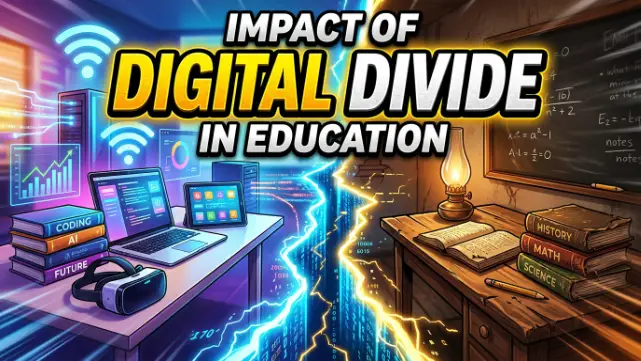
The digital divide in education is the gap between students who can access and use digital technology for learning – and those who cannot. It’s not a single gap. It’s three stacked on top of each other.
The first is the access divide: whether a student has a device and a reliable internet connection. The second is the skills divide: whether a student can use digital tools effectively, even when access exists. The third – and newest – is the AI divide: whether students benefit from adaptive, AI-powered learning tools, or fall further behind peers who do.
Each layer amplifies the one before it.
A student with a smartphone but no broadband can technically claim “internet access.” But attending an online class, submitting coursework, or running an adaptive learning platform on a shared 3G connection with inconsistent data coverage is not the same experience as a student with fiber broadband at home. As of 2026, 85% of urban dwellers use the internet, compared to just 58% in rural areas (ITU Facts and Figures, 2025). That 27-point gap isn’t closing fast.
How the Digital Divide Affects Academic Performance
The impact on learning outcomes is direct and measurable. Students without reliable internet access at home are less likely to complete homework, less likely to participate in online instruction, and more likely to fall behind in subjects where digital tools now shape how content is delivered.
This is the problem researchers call the “homework gap.” According to the National Education Association, it has become a primary barrier to educational equity as schools increasingly assign work that requires online access (NEA, 2025). Students from the lowest-income households are twice as likely as their peers to fall below acceptable connectivity thresholds outside of school hours (CoSN Home Internet Connectivity Report, 2022).
And it’s not just homework. It’s everything that follows.
Students who don’t use digital technology at school are less likely to build the digital literacy skills employers now treat as baseline requirements. They enter further education or the workforce without the foundational competencies their better-connected peers developed in class – not because they lacked ability, but because they lacked access.
The Numbers Behind the Gap
In the United States, just 57% of adults in households earning under $30,000 annually subscribe to home broadband, compared to 95% of households earning over $100,000 (Pew Research Center, 2026). That income-to-connectivity correlation runs through every level of the education system. As of 2026, over 15.7 million Americans still lack access to high-speed broadband (U.S. Census Bureau, 2026).
Globally, the numbers are wider. Sub-Saharan Africa accounts for 52% of the world’s population facing social exclusion due to the digital divide (DataReportal, 2025). As of early 2025, only 8.9% of global internet users came from Africa despite the continent holding roughly 17% of the world’s population (Statista, 2025).
These aren’t abstract figures. They map directly onto who graduates, who gets hired, and who gets left out of economic mobility entirely.
Case Study: A Secondary School in Rural Sylhet, Bangladesh
In 2024, a secondary school in a rural district of Sylhet, Bangladesh attempted to integrate a blended learning model across three Grade 9 classes. Two of the three classes had access to a newly installed computer lab with shared broadband. The third did not.
By the end of the academic year, the two connected classes outperformed the unconnected class by 18 percentage points on science assessments – a subject where the school had adopted a simulation-based teaching approach for the connected students. More telling was the gap in student engagement: teachers in the connected classes reported that students asked more questions, spent more time on self-directed review, and were more likely to arrive at school having completed the assigned pre-reading.
The unconnected class wasn’t failing. But they were working harder to stay in the same place.
The school’s headteacher framed it plainly: “The students in the lab aren’t smarter. They’re just able to practice more.” That’s the homework gap in one sentence. Access doesn’t create ability. But the absence of access puts a ceiling on how far ability can reach.
The Three Layers of the Digital Divide – and Why Each One Matters
Layer 1: The Access Divide
Access is the most visible dimension. No device, no connection, no participation. But measuring access by whether internet technically exists in an area misses the practical reality. Coverage is not the same as usability.
In South Africa’s rural Eastern Cape, a 2025 study of 200 residents found that 52.3% lacked internet access altogether. Of those who did have access, 38.5% identified affordability as the binding constraint – not unavailability (Springer Nature, 2025). Connectivity exists within reach, but not within budget.
In the United States, 25% of school districts have still not met the FCC’s minimum bandwidth benchmark of 1 Mbps per student (FCC Broadband Data, 2026). And 53% of middle and high school students name slow or inconsistent school Wi-Fi as their biggest barrier to using technology in class (Network Installers Digital Divide Report, 2026). That figure is worse than a decade ago.
Layer 2: The Skills Divide
Access alone doesn’t create learning outcomes. This is the part most device-distribution programs miss.
Research from China’s post-pandemic classroom environment found that rural teachers consistently reported discomfort using digital tools – not because the tools weren’t available, but because they had received no meaningful professional development to teach with them. The researchers labelled this the “TPACK divide” – a gap in Technological Pedagogical Content Knowledge (Frontiers in Computer Science, 2026). The problem wasn’t infrastructure. It was that teachers weren’t equipped to use what was already there.
Same problem, different continent. In Uganda, rural primary schools received devices through government programs but saw minimal change in learning outcomes because teachers had no structured training on how to integrate them into instruction (ResearchGate, 2026).
This part is boring but matters: a device in a classroom without a trained teacher to use it is just expensive furniture.
Layer 3: The AI Divide
This is the newest and least discussed layer, but it’s compounding faster than the others.
As AI-powered adaptive learning platforms become standard in well-funded schools, students in under-resourced environments aren’t just missing out on convenience features. They’re missing out on a fundamentally different learning experience – one where instruction responds to their pace, identifies knowledge gaps in real time, and provides personalised feedback without requiring teacher bandwidth to deliver it.
The Stanford Center for Racial Justice warned in 2024 that underserved populations face a higher risk of falling behind as AI becomes more central to education – not because AI is inherently biased against them, but because access to AI-powered tools tracks directly with existing income and connectivity disparities (Stanford Center for Racial Justice, 2024). Students who already trail in digital access fall further behind in AI access.
And AI systems trained on data from well-resourced, largely Western educational contexts may not reflect the needs, languages, or learning environments of students in South Asia, Sub-Saharan Africa, or rural communities anywhere (Frontiers in Computer Science, 2026). That’s an algorithmic dimension of the divide that device distribution won’t fix.
The Gender Dimension: A Divide Within the Divide
The digital divide doesn’t affect all students equally. Girls in low- and middle-income countries face a compounded disadvantage.
Globally, there are 244 million fewer women than men using the internet (Teachers Institute, 2026). In low-income countries, 90% of young women aged 15-24 are offline, compared to 78% of young men (ISPI, 2025). UNICEF data shows that in 41 countries surveyed, households were more likely to own mobile phones primarily for boys rather than girls.
UNESCO’s work in Ghana and Tanzania in early 2026 specifically targeted the digital gender gap in education – because closing overall internet access numbers while the gender gap inside those numbers remains untouched doesn’t constitute progress (UNESCO Digital Education, 2026).
The World Bank has committed to enabling 300 million more women to use broadband internet by 2030 (World Bank Gender and Digital, 2025). Whether that target is reachable depends largely on whether infrastructure investment in the next four years is paired with cultural and economic support that makes access usable, not just technically present.
Regional Snapshot: Where the Gap Is Widest
Sub-Saharan Africa
Over 50% of Sub-Saharan Africa’s population still lacks mobile broadband coverage (Pew Research / DevelopmentAid, 2025). The challenge isn’t only infrastructure – it’s that infrastructure investment in the region consistently arrives last in the places that need it most. Rural school connectivity lags behind urban school connectivity by margins that dwarf the urban-rural gaps in high-income countries.
South Asia
India has made real gains in mobile internet coverage – over 85% of Indian households now own a smartphone. But ownership doesn’t close the gap between a student with a mid-range device and intermittent mobile data, and a student with a laptop and dedicated home broadband. Within South Asia, Nepal and Bhutan face terrain-driven infrastructure challenges that keep campuses in rural areas offline while urban institutions sprint ahead (UNESCO-ICHEI, 2025).
Latin America
The World Bank and the Inter-American Development Bank launched the Connected Schools for All initiative in 2023 with a four-year mandate to expand digital infrastructure across Latin America and the Caribbean (World Bank Digital Education, 2025). Progress is measurable but uneven. Urban schools in Brazil and Colombia are pulling away from rural schools in the same countries as fast as they’re pulling away from lower-income nations in the region.
What Closing the Digital Divide Actually Requires
This is where most policy conversations stall. It’s easier to donate devices than to build the conditions that make devices educationally useful.
What research consistently shows is that closing the digital divide in education requires five things working at the same time:
- Reliable, affordable infrastructure – not just urban broadband but rural connectivity that actually reaches classrooms. As of 2026, over 94% of World Bank education projects included an EdTech component, primarily investing in digital infrastructure and learning platforms (World Bank, 2025). The investment is there. Distribution and prioritisation need work.
- Device access without recurring cost barriers – because a one-time device donation doesn’t solve the ongoing cost of data, repairs, or replacement.
- Teacher professional development – not a one-afternoon workshop but sustained training that builds pedagogical confidence with digital tools. The TPACK gap in rural China and Uganda is the same gap, different geography.
- Digital literacy as a curriculum component – GSMA data shows that in low- and middle-income countries, “lack of digital skills” is now a more common barrier to internet use than “lack of access” (GSMA Mobile Economy, 2025). Getting people connected doesn’t help if they don’t know how to use what they’re connected to.
- Gender-specific equity design – programs that don’t account for why girls specifically are offline in their communities will not close the gender dimension of the divide.
What Isn’t Working
Blanket device distribution without infrastructure is storage, not education. Broadband rollouts that stop at city limits leave rural schools in the same position they’ve always been in. And AI platforms built for Western, English-language contexts that get deployed in rural Bangladesh or rural Nigeria without localisation or pedagogical adaptation create new confusion, not new opportunity.
The World Bank noted plainly in 2025 that without deliberate safeguards, AI risks delivering machine-based learning to privileged students while under-resourced schools receive nothing at all (World Bank EdTech, 2025). That outcome isn’t hypothetical. It’s the current trajectory if policy doesn’t intervene.
How This Connects to Economic Mobility
The long-term impact of the digital divide in education isn’t just academic. It’s economic.
Students who don’t develop digital literacy at school enter job markets where digital skills are increasingly the baseline, not a differentiator. A Harvard Business School study of 40 million devices across 28,000 US ZIP codes found that rural populations lagged significantly behind urban areas in actual technology use – and that this gap, left unaddressed, constrains career trajectories precisely when AI is expected to reshape which functions jobs require (Harvard Business School, 2025).
The United Nations University put it directly in early 2026: governments, academic institutions, and businesses must treat education as the primary pathway to closing not just the digital divide, but the economic mobility gap it generates (UN University, 2025).
That’s not a stretch. It’s a documented feedback loop. No access means no skills. No skills means no credentials. No credentials means no economic mobility. And without mobility, the next generation faces the same gap.
Common Mistakes in Digital Divide Policy
- Measuring internet access as a binary: “Connected” and “not connected” misses the quality-of-connection dimension. A student on shared 3G is technically online. They are practically excluded from most digital learning tools.
- Treating device donation as a solution: One device per child is a starting point. Without infrastructure, training, and content in accessible languages, it doesn’t move learning outcomes.
- Ignoring teacher capacity: Infrastructure investment without educator professional development delivers hardware, not education. The TPACK research from China makes this failure pattern quantifiable.
- Building AI platforms for the connected majority: Tools calibrated for English-speaking, high-bandwidth users will underperform – or mislead – in low-bandwidth, multilingual classrooms.
- Skipping gender analysis in access programs: Programs that improve aggregate connectivity numbers while leaving gender gaps intact are measuring the wrong thing.
Frequently Asked Questions About the Digital Divide in Education
What is the digital divide in education?
The digital divide in education is the unequal access to technology, internet connectivity, and digital literacy that determines whether students can participate fully in modern learning environments. It operates across three levels: access to devices and broadband, the skills to use them effectively, and the ability to benefit from AI-powered educational tools.
How does the digital divide affect student learning?
Students without reliable internet access at home are less likely to complete homework, engage with online coursework, or build the digital literacy skills that future employers expect. Research links connectivity gaps directly to lower academic performance, higher dropout risk in digital-heavy curricula, and reduced access to higher education pathways.
Which countries are most affected by the digital divide in education?
Sub-Saharan Africa and South Asia face the widest gaps. As of early 2025, only 8.9% of global internet users came from Africa. In low-income countries broadly, only 27% of the population has internet access – compared to 93% in high-income countries. Within countries, rural-urban divides are severe across Latin America, South Asia, and Southeast Asia.
What is the homework gap?
The homework gap is the disparity between students who can complete internet-dependent homework assignments at home and those who cannot. It falls hardest on low-income and rural students. Research from the CoSN Home Internet Connectivity Report found that one in four socioeconomically disadvantaged students falls below adequate connectivity thresholds outside school hours.
How does the digital divide affect girls specifically?
Girls in low- and middle-income countries face a compounded disadvantage. There are 244 million fewer women than men using the internet globally. In low-income countries, 90% of young women aged 15-24 are offline. Cultural norms, affordability, and device access patterns that favour boys over girls mean gender-neutral infrastructure programs often fail to close the gender dimension of the divide.
What is the AI divide in education?
The AI divide is the emerging gap between students who benefit from AI-powered adaptive learning platforms and those who don’t. As AI tools become standard in well-funded schools, students in under-resourced environments miss out on personalised instruction, real-time feedback, and adaptive pacing – not because the technology doesn’t exist, but because they lack the connectivity and infrastructure to access it.
What are the most effective solutions to the digital divide in education?
Research consistently points to five simultaneous conditions: affordable and reliable broadband that reaches rural classrooms; ongoing device access without recurring cost barriers; sustained teacher training in digital pedagogy; digital literacy as a formal curriculum component; and gender-specific equity design in all access programs. Programs that address only one or two of these conditions produce limited, temporary results.
Key Takeaways
- The digital divide in education is three gaps stacked together – access, skills, and AI – and each one makes the next harder to close
- 2.2 billion people remain offline globally; the students most likely to be in that group are those in low-income, rural, and female-headed households
- The homework gap directly reduces academic performance among students who lack home internet – not because they lack ability, but because they lack access
- Closing the divide requires infrastructure, teacher training, digital literacy curricula, and gender-specific programs working simultaneously – not device donations alone
- The economic stakes are long-term: students who don’t develop digital skills in school enter job markets where those skills are the baseline, not a bonus