
Published: June 2, 2026 | Last updated: June 2, 2026 | 9 min read
TL;DR
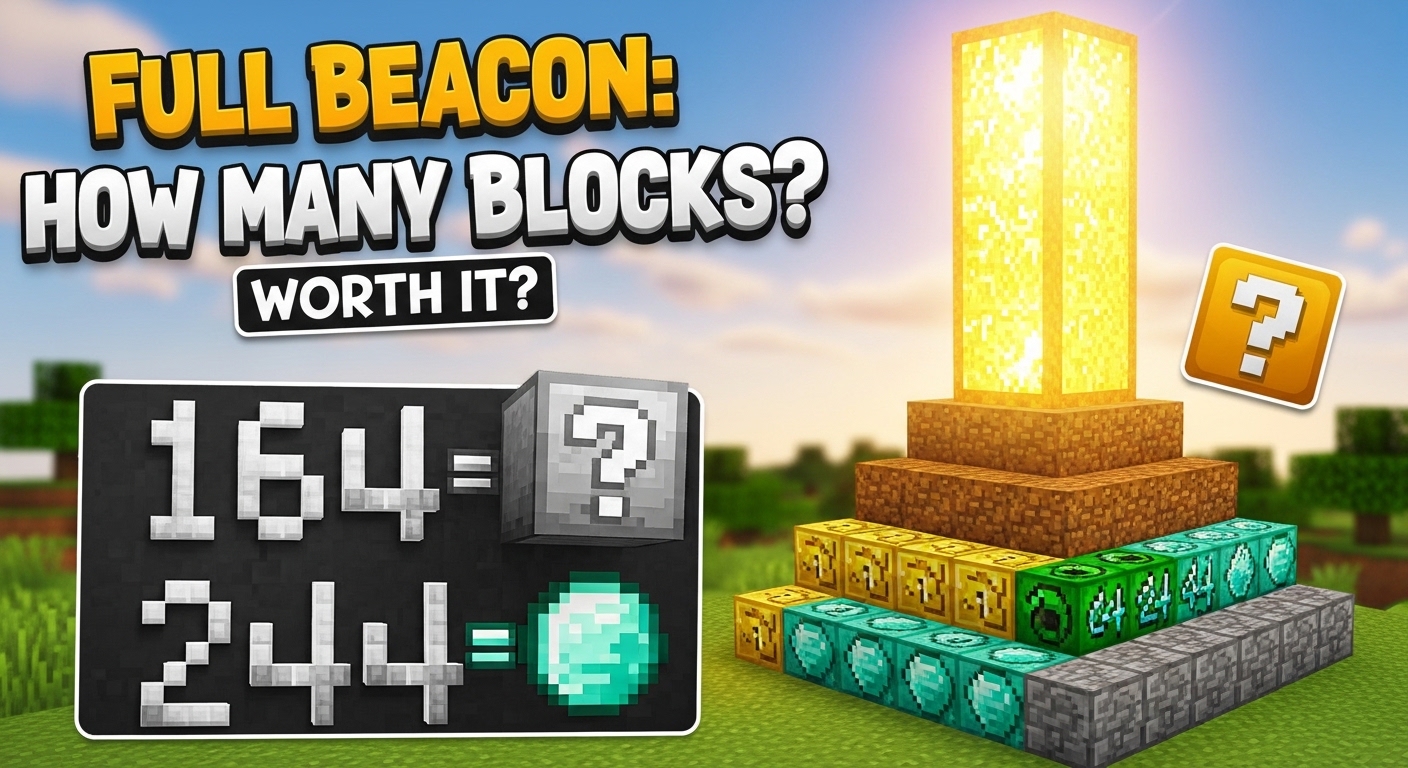
- A full beacon pyramid requires 164 mineral blocks across four layers plus the beacon block on top
- The four layers need 9, 25, 49, and 81 blocks respectively from top to bottom
- You can use iron, gold, diamond, emerald, netherite, or any combination of these mineral blocks
- A fully activated beacon grants two simultaneous permanent status effects within a 50-block radius
- The resource cost is high but the permanent buffs – especially Haste II and Speed II – make late-game mining and exploration dramatically faster
How Many Blocks Does a Full Beacon Need?
A full beacon pyramid in Minecraft requires 164 mineral blocks in total. These blocks form a four-layer stepped pyramid with the beacon block placed on the very top center.
The layer breakdown from bottom to top:
| Layer | Grid Size | Blocks Required |
|---|---|---|
| Layer 1 (bottom) | 9×9 | 81 blocks |
| Layer 2 | 7×7 | 49 blocks |
| Layer 3 | 5×5 | 25 blocks |
| Layer 4 (top) | 3×3 | 9 blocks |
| Total | — | 164 blocks |
The beacon block itself sits on top of the pyramid center and is not counted in the 164. That block is crafted separately and placed after the pyramid is built (Minecraft Wiki, 2024).
What Is a Beacon in Minecraft?
A beacon is a craftable block that projects a beam of light into the sky and grants permanent status effect buffs to nearby players. It was added to Minecraft in Java Edition 1.4.2 in October 2012 (Minecraft Wiki, 2024).
Unlike potions or food buffs that expire after a set time, beacon effects persist indefinitely as long as the player stays within range. Leave the radius and the effect fades after a few seconds. Return and it reactivates automatically.
The beacon beam is also a landmark. It shoots straight up through the sky and is visible from hundreds of blocks away, making it one of the best base markers in the game.
What Blocks Can You Use for the Pyramid?
The pyramid accepts any of the following mineral blocks:
| Block | Material Source | Relative Difficulty |
|---|---|---|
| Iron Block | 9 iron ingots | Common, easiest to farm |
| Gold Block | 9 gold ingots | Moderate, farmable via Nether |
| Diamond Block | 9 diamonds | Hard, requires deep mining |
| Emerald Block | 9 emeralds | Hard, requires villager trading |
| Netherite Block | 9 netherite ingots | Very hard, rarest material |
You can mix and match. A pyramid does not need to be one material throughout. Most survival players use iron blocks because iron is the most renewable and farmable mineral in the game (Minecraft Wiki, 2024).
At 164 blocks of iron, that translates to 1,476 iron ingots for a full pyramid. An iron farm producing around 1,000 ingots per hour – achievable with a standard mob-based iron farm design – can supply a full beacon pyramid in under two hours of farm runtime (Fandom Minecraft Wiki, 2024 ).
How to Craft the Beacon Block
The beacon block itself requires five glass blocks, three obsidian, and one Nether Star.
| Crafting Grid | Contents |
|---|---|
| Top row | Glass, Glass, Glass |
| Middle row | Glass, Nether Star, Glass |
| Bottom row | Obsidian, Obsidian, Obsidian |
The Nether Star is the gating ingredient. It only drops from the Wither boss, which means you must defeat the Wither at least once before placing any beacon (Minecraft Wiki, 2024).
Glass and obsidian are straightforward to gather. The Wither fight is the real barrier – it is one of the two boss encounters in Minecraft alongside the Ender Dragon, and it requires three Wither Skeleton skulls to summon, each with a low drop rate from Wither Skeletons in Nether Fortresses (Minecraft Wiki, 2024).
How to Build the Full Beacon Pyramid: Step-by-Step
Step 1: Gather Your Materials
Before building, you need:
- 164 mineral blocks (iron recommended for most survival players)
- 1 beacon block (requires a Nether Star from the Wither)
- A flat surface or cleared area at least 9×9 blocks wide
Step 2: Build Layer 1 (9×9, 81 blocks)
Place an 81-block foundation in a 9×9 square on the ground. This is the widest and most material-intensive layer. Center it where you want the beacon to stand.
Step 3: Build Layer 2 (7×7, 49 blocks)
Starting one block in from each edge of Layer 1, place the 7×7 second layer directly on top. Each side steps inward by one block, creating the pyramid profile.
Step 4: Build Layer 3 (5×5, 25 blocks)
Step in one block again from Layer 2 and place the 5×5 third layer. The pyramid shape should be clearly visible at this point.
Step 5: Build Layer 4 (3×3, 9 blocks)
Place the final 3×3 layer on top of Layer 3. This is the platform the beacon block will sit on.
Step 6: Place the Beacon Block
Put the beacon block in the exact center of the 3×3 top layer. The beam activates immediately if the pyramid is built correctly and the sky above is unobstructed.
Step 7: Activate the Effects
Right-click the beacon block to open its interface. Insert one mineral item (iron ingot, gold ingot, diamond, emerald, or netherite ingot) as payment, then select your desired primary and secondary effects. Click the checkmark to confirm (Minecraft Wiki, 2024).
What Effects Does a Full Beacon Give?
A fully built four-layer beacon unlocks the complete effect menu. You select one primary effect and one secondary effect simultaneously.
Primary Effects (choose one)
| Effect | What It Does |
|---|---|
| Speed | Increases movement speed |
| Haste | Increases mining and attack speed |
| Resistance | Reduces all incoming damage |
| Jump Boost | Increases jump height and reduces fall damage |
| Strength | Increases melee damage |
Secondary Effect (Level II upgrade or Regeneration)
With a four-layer pyramid, you can either:
- Upgrade your chosen primary effect to Level II (stronger version), or
- Add Regeneration as a second simultaneous effect
Regeneration passively restores health over time and stacks with the primary effect. Most players choose Haste II as the primary for mining efficiency, or Speed II for exploration (Minecraft Wiki, 2024).
Beacon Effect Range by Pyramid Size
You do not need a full four-layer pyramid to start benefiting from a beacon. Smaller pyramids unlock fewer effects at shorter range.
| Pyramid Layers | Blocks Required | Effect Range | Effects Unlocked |
|---|---|---|---|
| 1 layer | 9 blocks | 20 blocks | Speed, Haste |
| 2 layers | 34 blocks | 30 blocks | + Resistance, Jump Boost |
| 3 layers | 83 blocks | 40 blocks | + Strength |
| 4 layers (full) | 164 blocks | 50 blocks | + Secondary effect or Level II |
A single-layer beacon costs just 9 blocks and gives Speed or Haste within a 20-block radius. That is a reasonable early investment if you are not yet ready for the full pyramid (Minecraft Wiki, 2024).
Why a Full Beacon Is Worth the Investment
The resource cost is real. 164 iron blocks means 1,476 iron ingots, plus the Wither fight for the Nether Star. That is a significant late-game milestone. But here is why players consistently rate the full beacon as one of the best permanent upgrades in the game.
Haste II transforms mining. Haste II increases mining speed by 40% compared to baseline. Combined with an Efficiency V diamond or netherite pickaxe, stone breaks nearly instantly. A full mining session with Haste II active covers ground that would take two to three times longer without it. For players doing large underground builds, branch mining, or strip mining for diamonds, this compounds into hours saved (PCGamesN, 2024).
Speed II makes the overworld manageable. Minecraft’s world is effectively infinite. Speed II at 50-block radius means your base and its surrounding work area is permanently fast to navigate. Combined with a horse or elytra, overworld travel becomes dramatically more efficient.
Resistance reduces survival pressure. Late-game players who are no longer grinding for gear can use Resistance to make routine combat – cave exploration, farm defense, mob grinding – lower stakes. It does not make you invincible but it meaningfully reduces the frequency of unexpected deaths.
Regeneration stacks with everything. Adding Regeneration as the secondary effect means your health passively refills during any activity within range. This eliminates most food consumption for healing while working near your base, which matters in survival worlds where food farms may not be fully optimized yet.
The beam is a permanent landmark. This sounds minor but it is genuinely useful. Beacon beams are visible from over 500 blocks away in clear conditions. In a world where you have multiple bases or often travel far from home, the beam acts as a GPS anchor that never requires a map or coordinate check (Fandom Minecraft Wiki, 2024).
How Many Ingots Does a Full Beacon Cost by Material?
Since 1 mineral block = 9 ingots, and a full pyramid needs 164 blocks:
| Material | Blocks Needed | Ingots/Gems Needed | Difficulty |
|---|---|---|---|
| Iron | 164 | 1,476 iron ingots | Low – farmable via iron farms |
| Gold | 164 | 1,476 gold ingots | Medium – Nether gold farming |
| Diamond | 164 | 1,476 diamonds | High – deep mining or trading |
| Emerald | 164 | 1,476 emeralds | High – villager trading grind |
| Netherite | 164 | 1,476 netherite ingots | Extreme – ancient debris mining |
A netherite beacon pyramid is a purely prestige build. There is no functional advantage over iron. Iron is the practical choice for any survival player who wants the beacon effects without an extreme time investment (Minecraft Wiki, 2024).
Can You Change Beacon Effects After Activation?
Yes. Right-click the beacon at any time to reopen the interface. Insert another mineral item as the activation fee and select different effects. The change takes effect immediately after confirming.
There is no cooldown and no penalty for switching. Players commonly swap effects based on activity – Haste II for a mining session, then Speed II for exploration, then Resistance for a boss fight. Each swap costs one ingot or gem as the fee (Minecraft Wiki, 2024).
Can You Color the Beacon Beam?
Yes. Placing a stained glass block or stained glass pane anywhere in the beam’s path changes the beam color to match the glass. Stack multiple colors of glass for blended tones.
The color change is purely cosmetic and does not affect the beacon’s range or effect strength. It is one of the most accessible decoration tools for base building because the glass can be placed and removed without touching the pyramid itself (Minecraft Wiki, 2024).
Sixteen standard dye colors translate directly to stained glass, giving a wide range of beam options. Red, blue, and purple beams are popular for themed bases. Green works well for nature-themed builds. Combining orange and yellow glass produces a warm amber tone (IGN Minecraft Guide, 2024).
How Many Beacons Can You Have at Once?
There is no limit. You can build as many beacons as your resources allow, and each one provides its own effect radius and effect selection independently.
Large-scale Minecraft bases sometimes use beacon grids – multiple beacons positioned so their 50-block radii overlap, covering an entire megabase with several different effects simultaneously. A common combination is one beacon for Haste II, one for Speed II, and one for Regeneration + Resistance, placed so all three radii cover the main working area (Minecraft Wiki, 2024).
Each beacon in a grid needs its own pyramid. Shared pyramid blocks do not count for multiple beacons – each one requires its own independent 164-block structure.
Common Mistakes When Building a Beacon Pyramid
Blocking the beam with a roof: The beacon beam must have a clear path to the sky. Any opaque block placed directly above the beacon cancels the beam and deactivates all effects. If your base has a ceiling, leave the beacon area open or use transparent blocks like glass above it.
Off-center beacon placement: The beacon block must sit in the exact center of the top layer. Placing it one block off center breaks the pyramid structure check and the effects do not activate. Double-check the center of your 3×3 top layer before placing.
Using non-mineral blocks: Only the six valid mineral blocks count toward the pyramid. Stone, wood, and other blocks do not register. A pyramid built with non-qualifying blocks shows no beam and grants no effects even if the shape is correct.
Forgetting the activation payment: A correctly built pyramid shows the beam but does not grant effects until you open the beacon interface, insert a valid item, and select effects. The beam appearing does not mean effects are active.
Placing the pyramid indoors without a skylight: The beam needs sky access. Building your pyramid in an enclosed base without cutting a hole in the ceiling above the beacon blocks the beam entirely (Minecraft Wiki, 2024).
Frequently Asked Questions About the Full Beacon Pyramid
How many blocks do you need for a full beacon in Minecraft?
A full four-layer beacon pyramid requires 164 mineral blocks. The layers use 81, 49, 25, and 9 blocks from bottom to top. The beacon block itself sits on top and is not included in this count (Minecraft Wiki, 2024).
What is the cheapest way to build a full beacon pyramid?
Iron blocks are the most practical choice. Iron is renewable through iron golem farms and is far more accessible than diamonds, emeralds, or netherite. A functional iron farm can produce enough ingots for 164 iron blocks in under two hours of runtime (Fandom Minecraft Wiki, 2024).
Can you mix different block types in the beacon pyramid?
Yes. The pyramid accepts any valid combination of iron, gold, diamond, emerald, and netherite blocks. Mixing materials does not reduce the pyramid’s effectiveness. Most players mix based on what they have available (Minecraft Wiki, 2024).
How do you get the Nether Star for the beacon?
Defeat the Wither boss. Summon it by placing four soul sand or soul soil blocks in a T-shape and placing three Wither Skeleton skulls on the top row. The Wither drops one Nether Star on death. Wither Skeleton skulls have a low base drop rate of 2.5% per skull (Minecraft Wiki, 2024).
What is the best beacon effect combination?
Haste II as the primary effect is the most consistently useful for survival players, as it dramatically speeds up mining. Regeneration as the secondary effect provides passive health recovery during all work near the base. For combat-focused players, Strength II primary with Resistance secondary is a strong alternative (PCGamesN, 2024).
Does a beacon work underground?
Yes, as long as the beam has a clear unobstructed path directly upward to the sky. The pyramid and beacon block can be built underground or inside a mountain. The beam travels through water and air but is blocked by any solid opaque block directly above the beacon (Minecraft Wiki, 2024).
How far does a full beacon’s effect reach?
A fully built four-layer pyramid extends the effect radius to 50 blocks in all directions from the beacon block. Players within that radius receive the active effects continuously. Moving outside the radius causes effects to fade within a few seconds (Minecraft Wiki, 2024).
Is a beacon worth building in Minecraft?
Yes for late-game survival play. The Wither fight and material cost are significant barriers, but permanent Haste II or Speed II within a 50-block working radius saves more time than the investment costs over a long playthrough. The beacon is one of the few items in Minecraft that provides a genuine permanent quality-of-life upgrade with no expiry (IGN Minecraft Guide, 2024).
Key Takeaways
- A full beacon pyramid needs 164 mineral blocks arranged in four layers of 81, 49, 25, and 9 blocks
- Iron blocks are the most practical material – 164 blocks requires 1,476 iron ingots, achievable through iron golem farms
- The beacon block requires a Nether Star, which only drops from the Wither boss
- A fully activated beacon provides two simultaneous permanent effects – one primary at Level II and one secondary – within a 50-block radius
- Haste II is the most universally valuable effect for survival players, dramatically cutting mining time across any long playthrough
- Beacon beams can be colored with stained glass and multiple beacons can be used simultaneously to cover large base areas with different effects