
Published: June 27, 2026 | Last updated: June 27, 2026
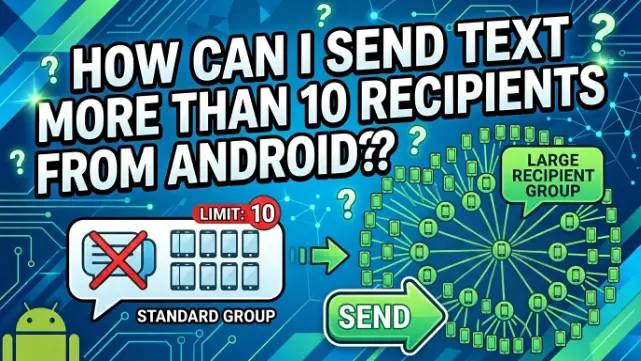
You’ve probably hit this wall before: you’re trying to send a group text to more than 10 people, and your Android messaging app simply won’t let you add more recipients. This is a standard limitation built into SMS and MMS group messaging protocols. Samsung confirms that the default Messaging app supports group SMS to a maximum of ten contacts, and larger messages automatically convert to MMS (Samsung 2026). But you have multiple ways around this limit, depending on your needs.
TL;DR
- Default Android messaging apps typically limit SMS/MMS groups to 10-20 recipients (Samsung 2026; Tom’s Guide Forum 2025).
- RCS group chats support up to 100 participants, but all recipients need RCS enabled (Cricket Wireless 2026).
- Third-party messaging apps like WhatsApp, Telegram, and GroupMe bypass SMS limits entirely.
- Bulk SMS apps can send personalized messages to thousands of recipients via Excel or CSV import (SA Group Text Lite 2026).
- Mixed iPhone/Android groups often force SMS/MMS fallback with lower limits, requiring alternative solutions (Tom’s Guide Forum 2025).
Understanding Android’s Default Group Text Limit
The 10-person limit isn’t a bug. It’s a carrier-level constraint built into SMS and MMS. Samsung’s support documentation explicitly states that the default Messaging app supports sending group SMS to a maximum of ten contacts (Samsung 2026). When you exceed this limit, your app may prevent you from adding more contacts, or the message may fail to send.
Android devices have varying limits. Some stock messaging apps cap groups at 10, while others allow up to 20 or 25 recipients per MMS group (Tom’s Guide Forum 2025). Sparrow SMS confirms that most default messaging apps limit group texting to 10 recipients, and group messaging must be disabled to send broadcast-style messages to larger groups (Sparrow SMS 2024).
The message length also matters. Samsung notes that any message over the maximum size (sometimes 160 characters) will automatically be sent as MMS, which may have its own recipient limits (Samsung 2026).
RCS: The 100-Person Solution Within Your Default App
RCS (Rich Communication Services) is the modern messaging standard replacing SMS and MMS. RCS group chats support up to 100 participants, a significant upgrade from the 10-20 SMS/MMS limit (Cricket Wireless 2026; AT&T 2026).
The catch: everyone in the group must have RCS enabled. Cricket Wireless notes that they’re migrating all RCS support to Google Messages, as it offers the best RCS interoperability with more devices, including iPhones (Cricket Wireless 2026). If some group members don’t have RCS, the chat reverts to the lower SMS/MMS limit.
To use RCS group messaging:
- Ensure everyone in your group has Google Messages installed
- Confirm RCS is enabled in settings
- Create your group chat normally
- If the group stays within the RCS environment, you can add up to 100 participants
The Mixed iPhone and Android Problem
Mixed groups with both iPhone and Android users present a special challenge. As one Tom’s Guide user described, a group of 29 people with both iPhone and Android users couldn’t send messages because carriers block large MMS groups when Android users are involved (Tom’s Guide Forum 2025).
iPhone’s iMessage can handle 29 people fine, but only if everyone is on iMessage. As soon as a single Android user is added, it has to fall back to MMS, and carriers often block large MMS groups. Most stock Android messaging apps impose a cap of 10, 20, or 25 recipients per MMS group (Tom’s Guide Forum 2025).
The solution: third-party messaging apps that work across both platforms.
Third-Party Messaging Apps: The Most Practical Solution
Third-party messaging apps bypass carrier SMS limits entirely by sending messages over the internet. They work across Android and iOS and don’t have the same carrier-imposed limits.
WhatsApp is the most widely used option, supporting group chats with up to 1,024 participants. Its popularity means most people already have it installed.
Telegram stands out for its massive group capacity – up to 200,000 members – making it ideal for large communities and organizations.
GroupMe is specifically designed for group texting and supports up to 200 recipients per message. It works across both platforms and allows you to message people who don’t have the app installed via SMS fallback (Laurie Excel 2024).
Signal focuses on privacy and security with end-to-end encryption by default, supporting groups up to 1,000 participants.
The main requirement: everyone needs to download the app. For many groups, this is the simplest and most reliable approach.
Bulk SMS Apps for Mass Texting
If you need to send traditional SMS to large groups and want personalization, bulk SMS apps are excellent options.
SA Group Text Lite allows you to import contact lists from Excel files and send personalized messages to thousands of recipients (SA Group Text Lite 2026). Features include:
- Importing group text from Excel files via USB or email
- Message personalization with tags like {firstname}, {lastname}, and {company}
- Scheduling messages for specific times
- Support for dual SIM devices
- Importing and sending more than 10,000 personalized messages at once (SA Group Text Lite 2026)
Due to Android’s limitation of 100 SMS per hour per app, you need to install SA Group Text plug-ins to extend this limit. After downloading plug-ins, grant Send SMS permission to these plug-ins in your phone’s app manager settings.
MSMS is an alternative to your default SMS handler that allows sending one message to multiple contacts at the same time. It offers features like sending lists, tracking delivery, and resending failed messages (MSMS 2025). It supports unlimited recipients and background service.
Bulk Sender – SMS Messenger is a powerful default SMS app that helps you manage messages and send bulk SMS easily. Features include group creation, contact import (manual, phonebook, or CSV), message templates, and delivery reports (Bulk Sender 2026). It must be set as your default SMS app to function.
Handcent Next SMS offers group or mass texts to multiple recipients with AI capabilities, cloud backup, and cross-platform support. It includes a built-in ChatGPT integration and supports bulk mass SMS and MMS (Handcent 2026).
Workarounds Within Default Apps
If you prefer using your phone’s default apps, there are some workarounds to consider.
Switch messaging apps: Some users report that switching from Samsung Messages to Google Messages can bypass the 10-person limit. This is because Google Messages supports RCS natively, enabling larger group chats (Tom’s Guide Forum 2025).
Group messaging settings: Some phones allow you to change the group messaging setting to “Send SMS to all recipients and receive replies one by one” rather than MMS. This can sometimes work around limits by sending individual messages rather than true group chats (Bulk SMS Sender 2025).
Message size limits: Long messages automatically convert to MMS, which may have different recipient limits. Keeping messages short can sometimes help you stay within SMS limits.
Bulk SMS vs. Group Texting: What’s the Difference?
Understanding the distinction between bulk SMS and group texting helps you choose the right approach.
Group texting creates a true group chat where all recipients can interact and see each other’s responses. This is what you’re doing when you send a group message from your default messaging app. These have limits set by carriers and messaging apps (10-20 recipients).
Bulk SMS sends individual messages to each recipient, similar to email BCC. Recipients see the message as a personal text from you, not as part of a group. Recipients can’t see each other’s responses or contact information (Sparrow SMS 2024). Bulk SMS apps can send to thousands of recipients without the same carrier-imposed group limits.
For businesses and mass communications, bulk SMS is often the better choice. For true group discussions, group texting or third-party messaging apps are more appropriate.
Frequently Asked Questions
Can I send a text to more than 10 recipients from Android?
Yes, but it depends on your method. Default SMS/MMS apps typically limit group texts to 10-20 recipients (Samsung 2026). RCS group chats support up to 100 participants when everyone has RCS enabled (Cricket Wireless 2026). Third-party apps like WhatsApp, Telegram, and Signal allow much larger groups.
What’s the best app for sending mass SMS messages on Android?
SA Group Text Lite, MSMS, and Bulk Sender are all excellent options. SA Group Text Lite supports sending to more than 10,000 personalized recipients via Excel import (SA Group Text Lite 2026). MSMS supports unlimited recipients with real-time tracking (MSMS 2025). Bulk Sender offers group creation and delivery reports (Bulk Sender 2026).
Why does Android limit group texts to 10 people?
The limit is set by carriers and messaging apps to manage network traffic and prevent spam. Samsung confirms that the default Messaging app supports group SMS to a maximum of ten contacts (Samsung 2026). Carriers often impose limits on MMS group sizes as well.
How can I send a group text to mixed iPhone and Android users?
Mixed groups often fail due to the MMS limit. Use third-party messaging apps like WhatsApp, Telegram, Signal, or GroupMe, which work across both platforms and don’t have carrier-imposed limits (Tom’s Guide Forum 2025). Alternatively, use RCS if everyone has it enabled.
What’s the difference between bulk SMS and group texting?
Group texting creates a group chat where all recipients can interact. Bulk SMS sends individual messages to each recipient, similar to email BCC, and recipients can’t see each other’s responses (Sparrow SMS 2024). Bulk SMS is better for mass communications, while group texting is better for discussions.
Do I need to set a third-party app as my default SMS app?
It depends on the app. Some bulk SMS apps require being set as the default SMS app to function (Bulk Sender 2026). Others work alongside your default app. Always check the app’s requirements before installation.