
Published: May 22, 2026 | Last updated: May 22, 2026 | 8 min read
TL;DR
- A card skimmer is a small electronic device criminals attach to ATMs, gas pumps, and payment terminals to steal card information
- Skimmers read the magnetic stripe on your card and store your card number, expiration date, and cardholder name
- The number of compromised cards from skimming surged 96% from 2022 to 2023 (FICO, 2024)
- Digital skimming infected 4,500 new websites in 2022, a 129% increase from 2021 (Mastercard, 2024)
- Criminals often pair skimmers with hidden cameras to capture your PIN as you type
- The FBI estimates card skimming costs cardholders and banks over $1 billion every year
- Chip cards and contactless payments (Apple Pay, Google Wallet) significantly reduce skimming risk
What Is a Card Skimmer?
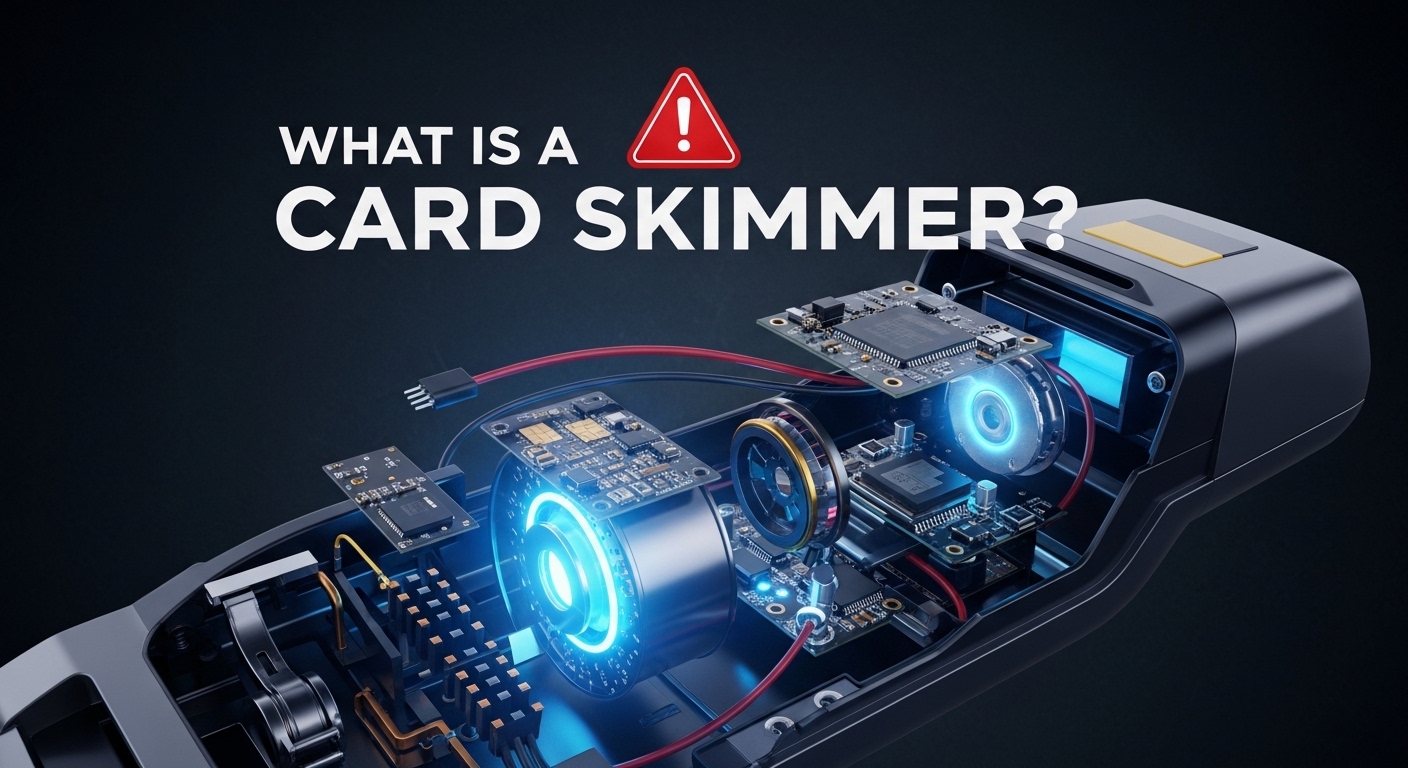
A card skimmer is a small electronic device that criminals attach to legitimate payment terminals to steal your card information. The device fits on top of ATM card readers, gas pump readers, or point-of-sale terminals at checkout counters. When you insert or swipe your card, the skimmer reads and stores your card number, expiration date, and cardholder name from the magnetic stripe (Huntress, 2026).
Skimmers are designed to blend seamlessly with the legitimate card reader. They look like they belong there. That’s the whole point—you shouldn’t be able to tell the difference between a real reader and a compromised one.
Card skimming is one of the sneakiest forms of theft because it happens instantly. You have no way to know your card was compromised at the moment of the transaction. Days or weeks later, when fraudulent charges show up on your statement, you realize something went wrong.
How Card Skimmers Actually Work: The Step-by-Step Process
Understanding how skimmers operate is your first line of defense. The process breaks into distinct stages, each one designed to capture different information.
Stage 1: Physical Installation
A criminal installs the skimmer on a payment terminal overnight or during low-traffic hours. The device mounts directly on top of the existing card slot. Some skimmers are placed inside the card slot itself you never see them. This makes detection harder because the terminal still works normally from your perspective (Experian, 2023).
Stage 2: Magnetic Stripe Reading
When you insert or swipe your card, the skimmer’s magnetic stripe reader captures the data encoded on the back of your card. This includes your card number, expiration date, and cardholder name. The skimmer stores this information in its memory (Discover, 2024).
Stage 3: PIN Theft (Optional but Common)
If the criminal wants your PIN as well, they install a hidden camera pointing at the keypad or place a fake keypad overlay on top of the real one. The fake keypad records your PIN as you type it. A hidden pinhole camera, nearly invisible to the naked eye, captures your hand movements and records what buttons you press.
Stage 4: Data Transmission
The criminal returns to retrieve the skimmer or, in more sophisticated setups, the data transmits wirelessly to a nearby receiver. Some modern skimmers use wireless technology, so the thief never has to return to physically collect the device (DataVisor, 2026).
Stage 5: Data Sale or Fraud
The stolen information is either used to create counterfeit cards or sold to fraudsters on the black market. In 2023, 416,582 cases of identity theft in the U.S. were facilitated by skimmed credit card data (Mastercard, 2026). The fraudsters use the credentials to make unauthorized purchases or drain bank accounts.
Where Skimmers Hide: The Most Vulnerable Places
Skimmers aren’t everywhere, but they cluster in specific places where criminals know you’ll use your card with minimal scrutiny.
ATMs are frequent targets, especially non-bank ATMs at convenience stores, grocery stores, and train stations. These machines are often unattended, giving criminals easy access to install or retrieve devices.
Gas pumps are the second-most common location. You’re focused on pumping gas, not inspecting the card reader. The pump sits unattended for hours at night, making installation simple.
Point-of-sale terminals at retail stores, restaurants, and ticket kiosks are also vulnerable. If your card leaves your sight at a restaurant or department store, an employee could use a skimmer to capture your data.
Self-checkout kiosks and vending machines represent newer attack surfaces. As more people use self-service options, criminals adapt their tactics accordingly.
Physical Skimmers vs. Digital Skimmers: Two Different Threats
Card skimming evolved into two distinct categories: physical device skimming and digital skimming.
Physical skimmers are the devices attached to card readers. You can theoretically spot them with careful inspection. Digital skimmers (also called e-skimming, online card skimming, or web skimming) are malware that criminals plant on legitimate e-commerce websites. When you enter your payment information during checkout, the malware harvests it (Mastercard, 2026).
Digital skimming is becoming more common. According to Mastercard data, nearly three-quarters of publicly disclosed breaches in 2022 involved digital skimming. That year, skimmers infected 4,500 new sites—a 129% increase from 2021. The number rose by another 2,700 in 2023 (Mastercard, 2026).
Digital skimmers are harder to detect because there’s nothing physical to see. They hide in the website’s code. You could be shopping at a legitimate, well-known website and never know malware is capturing your payment data.
The Evolution of Skimmers: From Magnetic Stripe to Shimming and Beyond
Criminals adapt as card technology improves. For decades, skimmers focused on magnetic stripe theft. Then chip cards became standard, and criminals developed “shimmer” devices—skimmers that can copy information from your card’s EMV chip.
Chip cards are more secure than magnetic stripe cards. The chip generates a unique transaction code each time you use it, making cloning much harder. But criminals found a workaround: shimmer devices read the chip data and use it for online fraud or in countries where chip cards aren’t standard yet.
Now criminals are moving toward wireless skimmers for contactless payments. These devices intercept communication between your card and the point-of-sale terminal, stealing data without physical contact. Some criminals have found ways to exploit vulnerabilities in contactless card systems, though card issuers constantly update security to stay ahead (DataVisor, 2026).
How to Spot a Card Skimmer Before You Swipe
Detecting a physical skimmer requires attention, but it’s possible. Here’s what to look for.
Check if the card reader looks different from others nearby. Does it stick out? Is the color slightly off? Does it look loose or wobbly? A skimmer mounted on top of the real reader might curve outward or have slight gaps.
Wiggle the card slot gently. A legitimate reader shouldn’t move. If it shifts, someone may have installed a skimmer on top.
Look for tiny cameras positioned near the keypad or at the top of the terminal. A hidden pinhole camera might be the size of a pencil point, but you can spot it if you look carefully. Tilt your head and look for reflective lens.
Check the keypad for overlays. If the numbers or buttons feel raised differently than expected, or if the keypad looks thicker than normal, someone may have placed a fake keypad on top of the real one.
If you notice scratches, unusual wear, or misaligned parts, skip that terminal and use a different one.
The Real Numbers: How Common Is Card Skimming?
Card skimming is more widespread than most people realize. The number of compromised cards from skimming surged 96% from 2022 to 2023.
The FBI estimates card skimming costs cardholders and banks over $1 billion every year (Mastercard, 2026). This isn’t a small problem. It’s a massive, growing threat affecting millions of people.
In the U.S. alone, 416,582 cases of identity theft in 2023 were facilitated by skimmed credit card data (Mastercard, 2026). That’s real people dealing with fraud, disputed charges, and the pain of cleaning up stolen identities.
The trend is accelerating. As digital skimming grows, the total impact on consumers and banks continues to rise.
How to Protect Yourself from Card Skimmers
Use the safest payment method available. Contactless payments like Apple Pay, Google Pay, or Samsung Pay are significantly harder to skim because your card doesn’t physically touch the reader. If contactless isn’t an option, inserting a chip card is safer than swiping a magnetic stripe (Experian, 2023).
Cover the keypad when typing your PIN. A camera might still record you through a keypad overlay, but covering your hand prevents at least some recording methods. It’s not foolproof, but every layer of protection helps.
Monitor your card statements closely. Check your account at least weekly for unauthorized charges. The faster you spot fraudulent activity, the faster you can notify your bank and minimize damage.
Use alerts and notifications. Set up text or email alerts for all transactions. This way, you’ll know immediately if someone uses your card.
Check your credit report regularly. Fraudsters sometimes open new accounts in your name. Regular credit monitoring catches this early.
If you notice a skimmer, don’t swipe. Report it immediately to the business and call your local police non-emergency number. Your report could prevent others from being victimized.
Frequently Asked Questions About Card Skimmers
How can I tell if my card has been skimmed?
You usually can’t tell immediately. Fraudulent charges may appear days or weeks later. Monitor your statement closely for unauthorized transactions. If you spot something wrong, contact your bank right away. Some banks flag suspicious activity automatically, notifying you before you even see the charge.
Can skimmers steal from chip cards?
Chip cards are harder to clone, but shimmer devices can still read chip data. However, chip cards generate unique transaction codes, making online fraud less effective. Contactless payments are even safer because your card never physically touches the reader.
What should I do if I think my card was skimmed?
Contact your bank immediately. They can freeze your account, dispute fraudulent charges, and issue a new card. Document all unauthorized transactions and keep records of your communication with the bank. You may also want to place a fraud alert on your credit report.
Are debit cards more vulnerable than credit cards?
Both can be skimmed, but debit card fraud is often more damaging because thieves have direct access to your bank account. Credit card fraud is easier to dispute. If you use a debit card, monitor your account daily and consider using a credit card for public terminals instead.
Is contactless payment safe from skimming?
Contactless payments are significantly safer, but not immune. Sophisticated criminals have found ways to exploit some vulnerabilities in contactless systems. However, the protection is much better than magnetic stripe or even chip cards.
Can ATMs inside banks be skimmed?
ATMs inside banks are less common targets because security is tighter. Criminals prefer unattended ATMs at convenience stores, train stations, or other public locations where they can install and retrieve devices undetected.
Key Takeaways
- Card skimmers are small devices installed on payment terminals to capture your card data and PIN
- Physical skimmers attach to card readers; digital skimmers hide in website code
- Skimming surged 96% from 2022 to 2023, costing over $1 billion annually (FICO, Mastercard)
- Criminals use hidden cameras and fake keypads to steal your PIN
- Chip cards are harder to clone than magnetic stripe cards, but shimmer devices still pose a risk
- Contactless payments and digital wallets offer the strongest protection
- Always monitor your card statements and set up transaction alerts
- If you spot a skimmer, don’t swipe—report it immediately
- Cover the keypad, use safe payment methods, and check card readers before use
- Regular credit monitoring catches identity theft early before major damage occurs