
[Published: May 13, 2026 | Last updated: May 13, 2026] | 8 min read
TL;DR
- An ATM skimmer is a fake card reader overlay placed directly over the real card slot to steal your debit or credit card data.
- They are designed to match the ATM’s color and material, making them hard to spot at a glance.
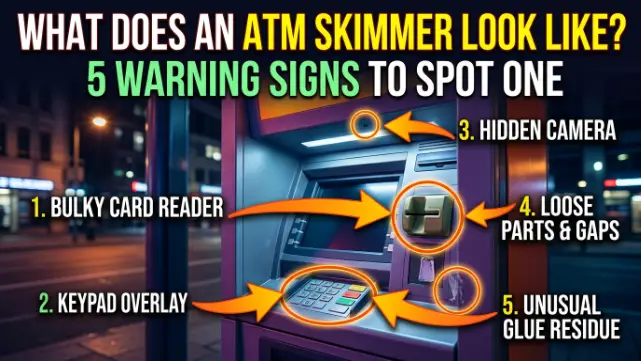
- The five physical signs: a bulky or protruding card slot, loose parts, sticky residue, a raised keypad overlay, and a pinhole camera near the screen.
- Newer “deep insert” skimmers (also called shimmers) sit inside the card slot and are invisible without a physical wiggle test.
- Skimming accounts for 77% of all ATM fraud cases globally, with over 280,000 debit cards compromised in 2025 alone (CoinLaw ATM Statistics, 2026).
What Is an ATM Skimmer and How Does It Work?
An ATM skimmer is an illegal device criminals attach over a real card reader to capture the data stored on your card’s magnetic stripe. When you insert your card, the skimmer reads and records your card number, expiration date, and account data – then sends or stores that information for the criminal to retrieve later.
Skimmers are shaped like overlays installed on top of the existing ATM card reader. They can also take the form of hidden cameras or false PIN pads, and are built to match the ATMs they are attached to.
The criminal then pairs the stolen card data with your PIN – captured either by a hidden camera aimed at the keypad or a fake keypad overlay placed on top of the real one – to create a counterfeit card and drain your account.
What Does an ATM Skimmer Look Like? The 5 Physical Signs
An ATM skimmer looks like a normal card reader. That is the point. But these five physical signals can give one away before you swipe.
1. A bulky or protruding card reader
Since skimming devices install over the top of the normal card reader, they often add extra thickness or bulk to the area. If the ATM card reader is sticking out further than expected, that is a red flag.
A regular card reader typically curves inward, while a card skimmer may curve outward. A skimmer might also block some of the buttons or other functions, making them difficult to press.
2. Sticky residue or visible adhesive
Criminals must use glue or tape to secure card skimmers. Since lingering too long at an ATM may look suspicious, the installation is often rushed, leaving sticky residue around the card reader that is easy to spot if you look for it. Scratches or damage around the reader are also a sign of tampering.
3. A loose part that shifts when touched
If the card slot appears loose, misaligned, or moves when you tug on it, it could be a skimmer attached over the original reader. Skimmers are often loosely attached and may shift or come off when pulled.
4. A raised or stiff keypad
Inspect the PIN pad to check if it looks raised or shows signs of damage, scratches, misalignment, or texture differences compared to the rest of the ATM. A fake PIN pad will likely come off if you try to pry it away from the machine.
5. A small camera or pinhole near the screen
Criminals place tiny cameras near the ATM to record your PIN. One real-world example: a gray rectangular box attached to the lighting above an ATM screen, with a small pinhole hiding a camera aimed directly at the keypad.
Extra plastic that seems unnecessary could be hiding a pinhole camera. Look for these attachments above the PIN pad or on the side of the ATM, paying attention to subtle differences in the material the ATM is made from.
The Newer Threat: Deep Insert Skimmers (Shimmers)
Traditional overlay skimmers are visible if you know what to look for. Newer devices are not.
Newer ATM skimmers, often called deep insert “shimmers,” are thin and difficult to detect with the naked eye. The criminal places the device directly inside the card slot. These shimmers capture card data, and the information can be transmitted via Bluetooth to the criminal, meaning they often do not even need to return to physically retrieve the device.
For these, the wiggle test and tactile check matter more than visual inspection. Feel the card as you slide it in and out. Any unusual friction or resistance could indicate that a skimmer or shimmer has been inserted into the card reader.
If an unfamiliar Bluetooth device shows as available on your phone near an ATM, do not connect – it may indicate a shimmer transmitting stolen data nearby (WESTconsin Credit Union, 2026).
How Common Is ATM Skimming in 2025-2026?
The scale of the problem is real and growing. Over 280,000 debit cards were compromised due to skimming in 2025, with nearly 3,400 financial institutions affected.
Skimming attacks accounted for 77% of ATM fraud cases globally, though EMV chip adoption continues to reduce risk in some regions. Global ATM fraud losses reached $1.5 billion, showing a slight decline due to strengthened countermeasures. (CoinLaw ATM Statistics, 2026)
According to the FBI, the financial sector and consumers together lose approximately $1 billion annually as a result of skimming.
Law enforcement operations confirm how widespread skimmer placement is. Fairfax County detectives, working with the U.S. Secret Service, searched 287 point-of-sale terminals, 158 ATMs, and 46 gas pumps in a single countywide operation in December 2025, recovering 20 skimming devices from multiple convenience stores, discount stores, and grocery stores.
Where ATM Skimmers Are Most Often Placed
Not all ATMs carry equal risk. Criminals target specific locations and machine types.
Outdoor and standalone ATMs are the highest-risk. They are accessible at all hours, often in low-traffic spots, and criminals can install devices with less chance of being seen.
Gas station pumps are a close second. The card readers on fuel pumps are frequently targeted because they go unchecked for long periods, especially pumps away from the cashier’s view.
Tourist areas and unfamiliar locations carry elevated risk. Popular destinations for visitors are hotspots for card skimmers, since travelers are not typically familiar with the machines and need to withdraw cash.
ATMs inside bank branches are the safest option. They are under camera surveillance and checked regularly by staff. Indoor ATMs are less likely to be skimmed compared to poorly lit, out-of-view terminals.
How to Check an ATM Before You Use It: A Step-by-Step Inspection
Run through these checks in under 30 seconds before inserting your card.
Step 1: Step back and look at the whole machine. Check for mismatched colors, unusual bulk, or any attachment that does not belong. A criminal may have installed the skimmer hastily, leaving uneven or sloppy results.
Step 2: Examine the card reader closely. Look for outward curves, extra thickness, or a card slot that appears smaller than normal. Cards may be difficult to insert into ATMs with skimmers.
Step 3: Wiggle the card reader and keypad. Grab the card slot and give it a firm tug. A real card reader is solidly mounted. A skimmer will feel loose, wobble, or pull away.
Step 4: Check the keypad. Press a button. If the buttons feel stiff, hard to press, or appear raised, something may be off. A fake keypad sits on top of the real one, so it will feel thicker than normal.
Step 5: Look above the keypad. Scan for extra plastic, small holes, or any attachment that does not match the machine’s body. That is where most hidden cameras are placed.
Step 6: Cover your PIN regardless. Always shield the keypad with your hand while entering your PIN, even if you do not see anything suspicious. A skimmer without a recorded PIN is largely useless to the criminal.
What to Do If You Suspect an ATM Has a Skimmer
Do not insert your card. Do not attempt to remove the device yourself.
- Walk away from the machine without completing a transaction.
- Report it to the bank or business that owns the ATM immediately.
- Alert local law enforcement or the non-emergency police line.
- If you already inserted your card, contact your bank right away to freeze the card and request a replacement.
- Monitor your account activity daily for at least two weeks after any suspicious interaction.
If you do insert your card into a terminal that may have had a skimmer, the best practice is to have a new card issued. Monitor your transaction history regularly – perpetrators of these schemes often use stolen data to make counterfeit cards and run them at gas pumps, ATMs, and other unmanned terminals.
How to Reduce Your Risk of ATM Skimming Going Forward
These habits significantly lower your exposure over time.
- Use tap-to-pay or contactless payments wherever available. Skimmers are ineffective against tap-to-pay, making it a safer option when available.
- Use ATMs inside bank branches rather than standalone outdoor machines.
- Check your account alerts. Set up SMS or email notifications for every transaction on your debit card so unauthorized charges appear within minutes, not days.
- Use chip-and-PIN instead of swiping. Chip transactions are far harder to clone than magnetic stripe reads. Chip cards reduce your risk of skimming because your card does not need to physically interact with a compromised machine in the same way.
- Avoid ATMs with broken or missing security seals. Many ATMs have tamper-evident stickers. If the seal is broken or appears tampered with, avoid using the machine.
Frequently Asked Questions About ATM Skimmers
What does an ATM skimmer look like?
An ATM skimmer looks almost identical to a real card reader because it is designed as an overlay that fits directly on top of the existing slot. Signs include a card reader that curves outward instead of inward, extra bulk around the slot, a keypad that sits higher than normal, small pinholes near the screen, and sticky residue or scratches around the card reader.
How do criminals get your PIN if a skimmer only reads the card?
Most skimmer setups include a second component to capture your PIN. A camera placed within the frame of the cash dispenser captures PIN numbers as the cardholder types them. Some criminals use a fake keypad overlay instead, which records every keystroke directly.
What is a shimmer and how is it different from a skimmer?
A shimmer is a newer, thinner version of a skimmer that sits inside the card slot rather than on top of it. It is invisible from the outside and cannot be spotted visually. The only way to detect one is to feel for unusual friction when inserting your card, or to notice an unknown Bluetooth signal near the machine.
Are chip cards safe from ATM skimming?
Chip cards are much harder to clone than magnetic stripe cards. However, criminals can still target the magnetic stripe data on a chip card if the card is swiped rather than dipped, and some counterfeit cards with intentionally damaged chips force machines to fall back to the stripe.
Which ATMs are safest to use?
ATMs inside bank branches, in well-lit high-traffic areas, and under active security camera coverage carry the lowest skimming risk. Standalone outdoor ATMs, gas pump terminals, and machines in isolated or dimly lit areas carry the highest risk.
Can I tell if I have been skimmed before my card is used fraudulently?
Not reliably from physical inspection alone. Set up real-time transaction alerts on your bank account. Any transaction you did not make will appear immediately. That is the most reliable early-warning system available to consumers.
Key Takeaways
- ATM skimmers are overlays placed on card readers to steal magnetic stripe data – they are designed to look exactly like the real machine.
- The five warning signs are: a bulky or protruding card reader, sticky residue or adhesive, loose parts that shift when tugged, a raised or stiff keypad, and a pinhole or extra plastic near the screen.
- Newer “deep insert” shimmers are invisible from the outside – use the wiggle test and watch for unusual card friction.
- Skimming accounts for 77% of global ATM fraud cases and compromised over 280,000 debit cards in 2025 (CoinLaw ATM Statistics, 2026).
- Tap-to-pay, chip transactions, indoor ATMs, and real-time account alerts are the most effective defenses.