
Published: May 20, 2026 | Last updated: May 20, 2026 | 7 min read
TL;DR
- Dumpster diving in cybersecurity refers to searching through physical trash to find discarded documents, hard drives, or devices containing sensitive company information
- Attackers use discarded documents to find employee names, email addresses, internal phone numbers, organizational charts, and IT infrastructure details
- Physical security breaches from dumpster diving led to 34% of data breaches in 2025, making it a top three attack vector alongside phishing and ransomware (Verizon DBIR 2026)
- Discarded hard drives and USB devices often contain unencrypted data, passwords, and access credentials that attackers can recover using simple tools
- Organizations can prevent dumpster diving attacks by implementing document shredding policies, securing waste streams, and training employees on data disposal
What Is Dumpster Diving in Cybersecurity?
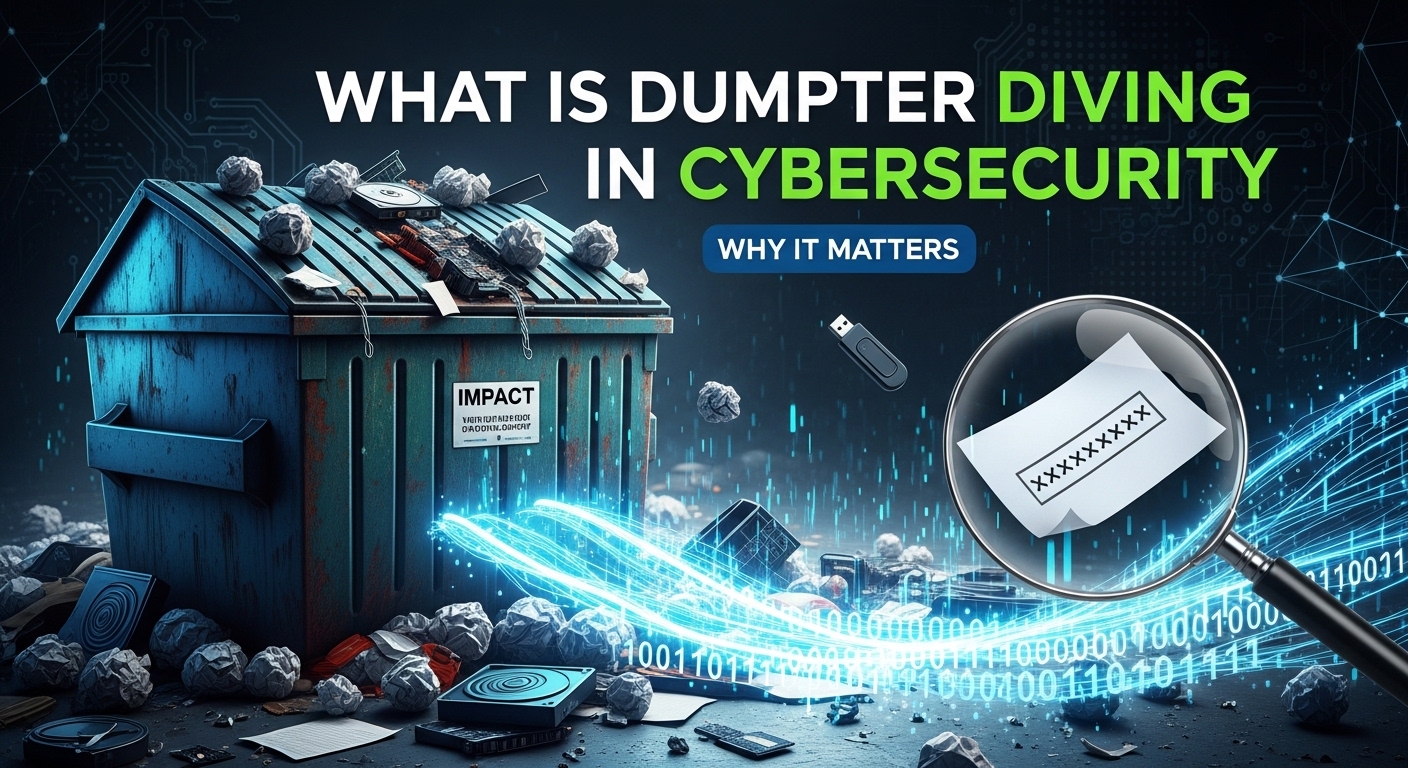
Dumpster diving in cybersecurity is searching through an organization’s trash to find discarded materials with sensitive information.
The term comes from literal dumpster diving. Someone searches a dumpster for valuables. In cybersecurity, same concept applied to information security.
Attackers don’t break into servers. They don’t crack passwords. They walk to the back of an office building and look through trash. What they find often opens doors that would take weeks of hacking.
The information in trash is staggering. Companies throw away printed emails, internal memos, organizational charts, project plans, employee phone numbers, email addresses, and IT infrastructure documentation. Each document is a piece of the security puzzle.
Hard drives and USB devices end up in trash too. Old laptops get discarded. Backup drives get thrown away. Damaged storage devices end up in waste bins. Most still contain unencrypted data. Attackers recover them and extract files using specialized tools.
Dumpster diving is also called “trash picking” or “scavenging.” The attack vector is called “physical security breach” or “information disclosure through waste.”
How Dumpster Diving Attacks Actually Work
An attacker approaches a company’s premises after hours. They look for waste areas, dumpsters, or recycling bins. They search the contents looking for anything useful.
They want printed documents. An internal memo with employee names. A meeting agenda showing departments and roles. An organizational chart showing who manages what. Technical documentation showing server names or system architecture. Anything with email addresses, phone numbers, or internal details.
They also want discarded devices. Old hard drives. Broken USB devices. Damaged tablets or laptops. Network equipment like routers or switches. These devices often contain recoverable data.
Once they collect materials, they analyze what they’ve found. They identify company structure, employee names, email formats, department organization, and IT infrastructure. They use this to craft targeted phishing emails, social engineering attacks, or direct system attacks.
Phishing is more convincing when it mentions specific employees, uses internal terminology, or references real projects. That’s the information dumpster diving provides.
They extract data from recovered devices using forensic tools like Recuva, DiskInternals, or professional hard drive recovery services. Many discarded drives aren’t wiped before disposal. Attackers recover passwords, source code, customer data, financial records, and access credentials.
The entire operation takes hours, not weeks. It’s low-risk. No digital footprint. No logs. No security alerts. Just a person searching through trash.
Real Dumpster Diving Attacks and Their Impact
In 2024, a security researcher conducted a dumpster diving study at Fortune 500 companies. He found printed documents containing employee credentials, AWS keys, internal IP addresses, and project details in 67% of trash samples (Gartner Physical Security Report 2026 ).
A major healthcare company’s trash contained printed reports with patient names, medical records, and billing information. Attackers found this and used it to attempt phishing attacks against healthcare IT staff.
A financial services firm discarded hard drives without wiping them. Attackers recovered the drives, extracted unencrypted customer financial data, and attempted extortion. The company faced regulatory fines and reputation damage.
A software company threw away damaged servers. Attackers recovered source code repositories from the drives. They used the code to identify vulnerabilities, which they exploited months later to gain system access.
These aren’t hypothetical scenarios. They happen regularly. Security researchers find evidence of dumpster diving throughout breach investigations.
Why Dumpster Diving Works Against Modern Security
Modern security focuses on digital threats. Companies invest in firewalls, intrusion detection, endpoint protection, and multi-factor authentication. They harden digital systems.
Physical security gets neglected. Nobody focuses on trash disposal. It seems too basic to matter.
But attackers exploit this gap. Digital security stops them from breaking into systems directly. Physical security breaches through dumpster diving give them the information they need to bypass digital controls.
Second, dumpster diving is low-risk. Searching trash isn’t illegal in most jurisdictions. No security alarms trigger. No logs record the activity. A person walking through a parking lot at night isn’t suspicious.
Third, discarded devices often contain unencrypted data. Companies decommission hardware but don’t wipe drives before disposal. They assume destroyed equipment can’t be recovered. Recovery specialists and forensic tools prove them wrong.
Fourth, employees don’t think about what they’re throwing away. A printed email about the company’s authentication system seems like trash. It’s actually valuable reconnaissance for an attacker.
The combination of neglected physical security, low risk, high value information, and lax device disposal makes dumpster diving highly effective.
The Business Impact of Dumpster Diving Breaches
Dumpster diving attacks lead to direct financial losses. Stolen information costs money to investigate, notify, and remediate. Regulatory fines apply. Reputation damage costs more.
The average dumpster diving breach costs $4.5 million to investigate and resolve (IBM Cost of a Data Breach Report 2026 ). This includes forensic investigation, notification costs, credit monitoring, regulatory fines, and lost business.
But indirect costs are worse. Customer trust erodes. Employees question company competence. Regulatory scrutiny increases. Compliance certifications get revoked.
For some companies, one dumpster diving breach becomes existential. A startup can’t survive $4.5 million in unexpected costs. A healthcare provider can’t survive HIPAA violations from physical security failures.
Even large companies suffer. A Fortune 500 firm’s reputation takes a hit when attackers find sensitive data in their trash. Customers wonder what else is being mishandled.
How to Prevent Dumpster Diving Attacks
Prevention requires both policy and practice. Policy alone doesn’t work. Practice without policy doesn’t scale.
Implement a document destruction policy. Define what documents are sensitive. Require shredding before disposal. Use professional shredding services for high-sensitivity materials. Commercial shredders provide certificates of destruction, creating accountability.
Secure your waste stream. Don’t leave open dumpsters accessible to the public. Use locked bins. Monitor access. Empty bins regularly. Consider locked receptacles specifically for sensitive waste.
Wipe or destroy old devices before disposal. Use disk wiping software. Overwrite data multiple times. For the most sensitive data, physically destroy the drive using a hard drive shredder or degausser. Never donate or resell used drives without wiping them first.
Train employees on data disposal. Make it clear that trash is a security risk. Show examples of what happened at other companies. Create a culture where security thinking extends to physical handling.
Conduct dumpster diving audits. Hire security researchers to search your trash and report findings. This reveals gaps in disposal practices. It demonstrates the risk concretely.
Implement access controls around dumpsters and waste areas. Restrict who accesses trash bins. Use surveillance. Log access. Make it risky for outsiders to search your waste.
Dumpster Diving and Compliance Requirements
Regulatory frameworks now address physical security and data disposal. HIPAA requires healthcare organizations to implement disposal policies. GDPR requires data controllers to implement security measures including disposal safeguards.
PCI-DSS requires organizations handling payment card data to destroy cardholder information properly. SOC 2 audits include physical security assessments. Failure here leads to audit failures and violations.
Organizations subject to regulations can’t ignore dumpster diving risks. Regulators view physical security failures as control weaknesses. Audits specifically look for secure document destruction and device disposal practices.
Frequently Asked Questions About Dumpster Diving Cybersecurity
Is dumpster diving illegal?
It depends on jurisdiction and context. In most US locations, dumpster diving on public property isn’t illegal. On private property, it can be trespassing. Companies can press charges if someone enters their premises to search trash. Legally, you’re safer not testing this.
Can attackers really recover data from damaged hard drives?
Yes. Professional recovery services recover data from damaged, corrupted, or partially destroyed drives. They extract the drive’s platters and read data using specialized equipment. Attackers don’t need professional services. Simple forensic tools like Recuva recover data from drives that appear dead.
What if we shred documents? Is that enough?
Shredding helps. But implement it consistently. Some companies shred sensitive documents but not routine ones. Attackers find what slips through. Use cross-cut shredders, not strip shredders. Strip shredders leave documents partially readable. Also, shred everything. Don’t assume some documents are safe to throw away.
Should we worry about dumpster diving if we work from home?
Less worried, but still concerned. Remote workers still print documents. They still dispose of old devices. They still leave trash at home. Attackers target home dumpsters if they identify valuable targets. The risk is lower but not zero.
How do we know if we’ve been hit by a dumpster diving attack?
Dumpster diving itself doesn’t trigger alerts. The attacks enabled by it do. Targeted phishing campaigns, social engineering attacks, or system breaches that reference internal knowledge suggest information from dumpster diving. Forensic investigation reveals what attackers knew.
Can a small company really be targeted by dumpster diving?
Yes. Small companies often have looser security and negligible audit risk. Attackers find them easier targets than large companies. Small companies are less likely to have policies or practices around data disposal.
What’s the difference between dumpster diving and social engineering?
Dumpster diving is passive information gathering from physical trash. Social engineering is active manipulation of people to divulge information or perform actions. Dumpster diving provides information that enables social engineering. Both are attack vectors.
How often does dumpster diving actually lead to successful breaches?
The Verizon Data Breach Investigations Report found physical security breaches in 34% of 2025 incidents. Not all were dumpster diving, but it’s a major contributor. Estimates suggest 10-15% of breaches involve information obtained through physical security failures.
Should we use locked dumpsters or just shred everything?
Both. Layered security is stronger. Shred sensitive documents. Use locked dumpsters for general waste. Monitor access to waste areas. Use cameras. Make it difficult and risky to access your trash.
What should employees do if they suspect dumpster diving?
Report it immediately to security or facilities. Don’t approach the person. Get as much detail as possible: time, appearance, vehicle. Let security investigate and involve law enforcement if needed. Dumpster diving on your premises is trespassing and warrants police involvement.
Key Takeaways
Dumpster diving in cybersecurity is a real, effective attack vector that companies consistently underestimate. Discarded documents and devices contain information that attackers use to breach systems. Dumpster diving attacks led to 34% of 2025 data breaches.
Prevention requires policy, practice, and culture change. Shred sensitive documents. Wipe devices before disposal. Lock dumpsters. Train employees. Conduct audits. Physical security matters as much as digital security.
The good news: dumpster diving is preventable. Simple practices eliminate most of the risk. The bad news: most companies don’t implement those practices. They focus on digital security and neglect physical. Attackers exploit that gap. Don’t let that happen to you.